
To celebrate our 40th Anniversary, the regiment will be reaching out to current and past members to collect memorabilia, pictures, stories, etc. We will digitize what we can and add them to our archives and make them available to everyone to view at a Regimental Gathering and online. The time and place of the gathering has yet to be determined but it will be early 2021, so stay tuned.
If you have anything you’d like to share with us, pictures, stories, news articles etc. Please email us at info@saintonge.org. Thank you
]]>Published in an article of Traditions Magazine, we find an illustration from Michel Petard illustrating the 1786 French Uniform. Figure 1. shows us the style of buckle worn by French Troops. It’s unclear if this is for the breeches or the gaiter or both. However, the buckle is said to be 2.3mm x 3.3mm and has an anchor on it so it can be attached and removed without sewing
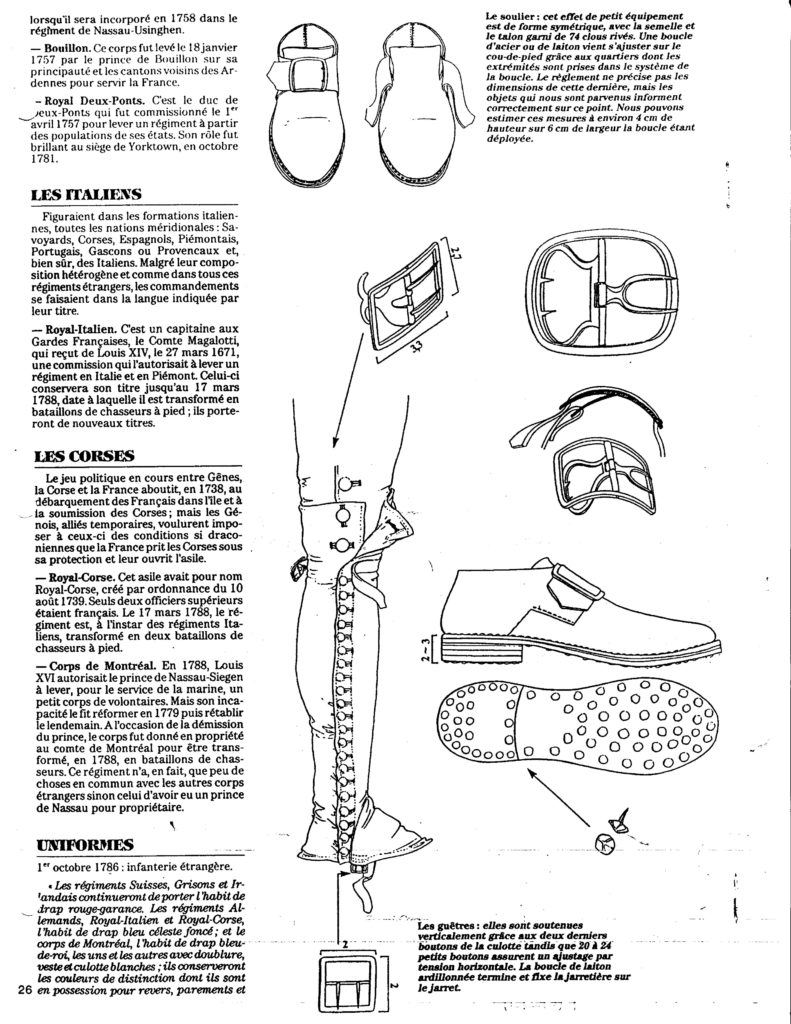
Les ETrangers Au Service De La France 1786, Petard, Tradition Magazine, pp21-29 w. technical drawings of chapeau chemise soulier guetres pokalem giberne
- Figure 2: Close up of the buckle form the Petard drawing in Figure 1
- Figure 3: Two buckles from an archeological dig at Gloucester Point.1
- Figure 4: Buckle sold by Flying Canoe and is sold as ‘French Gaiter Buckle’.

Figure 2
Close-up of buckle (fig.1)
Figure 3
Found at Gloucester Point
Figure 4
Flying Canoe


- If we put all three side by side, we can see these are all very similar. There a few differences
- The anchor is missing, but you can clearly see where it should be.
- The brass frame is wider than what we see in the drawing.
In conclusion, as the buckles in Figure 4 closely resemble that of those found at Gloucester Point, the Regiment Saintonge will use the style buckle show in Fig. 4 as the buckle for both the britches and gaiter knee straps.
1: Gloucester Point is the location of an engagement between French and British Calvary. The battle is known as the Battle of the Hook, which took place on October 3, 1781 ]]>Artist: Charles Eisen (Valenciennes 1720 – 1778 Brüssel)
Date: 1751 / 52
Title: Vier französische Soldaten mit angelegten Gewehren
(Four French soldiers with rifles laid out) ]]>
Over the past few years, in light of the Battle Road Regulations, we’ve challenged our selves to document every aspect of our uniform. It’s not a question of, where the founders of Saintonge right or wrong, it’s a question of, how did they come to this conclusion. We’ve been looking at museum pictures, regulations, diaries, etc to help us document our uniforms and equipment.
The biggest question on everyone’s mind is, what color was our ‘Green Trim’, and were can we find a sustainable source? The founders of the unit used Forest Green wool from Woolwich. WHY? Well our 1779 Regulations state “Vert Foncé” which translate to Dark Green. The founders of the unit looked at woolwich, found a dark green and went with it. It was a sustainable source and a logical choice. They used this green wool on everything, including the Linen Small clothes. There are too things wrong with that. 1) The 1779 uniforms do not mention wool on the linen small clothes; 2) You can’t just wash linen small clothes with wool on them. As we’ve seen over the years the wool shrinks, or bleeds, and sometimes it does both.

About 5 years ago, we went through a very lengthy task of finding a suitable linen for our small clothes. We weren’t just going to just through green wool on it and call it a day. So the search began to find green linen. Which brought back into question, what is the correct green and where do get it. Since the bicentennial a lot of research has been done into finding and even producing materials of the time period. We’ve had these experts tell us, ‘this is the green you should be using’. It turns out, that green they had shown us had more yellow than blue but was still considered a dark green. It didn’t really look like any other green we had seen or used before with Saintonge. This green found its way on to a coat and was ‘praised’ as the correct color. But is it?
Today a very interesting thing fell into our lap. A picture of wool swatches from the French National Archives. These wools where being produced in France and sold to the Spanish in 1762. The label for the last color is cut off, but we believe it to be “Vert Foncé ” Which is what is called out on our 1779 Regulations. Is this it, have we found it? If so, once again the founders had it right, but now we have something we can point to say, ‘this is why we have chosen this shade of green’.

http://www.archives-nationales.culture.gouv.fr
https://www.facebook.com/Archives.nationales.France/photos/a.202938916436141/1752232578173426/?type=3&theater